Public Records give Kane County residents instant, free pathways to land deeds, court filings, and marriage licenses without endless paperwork. By tapping the county’s public records portal, you can pull property details, criminal histories, or archived genealogical files in minutes, all while staying within the public records access laws that protect privacy and ensure transparency. This fast‑track approach cuts wait times, sidesteps hidden fees, and lets you verify information before any major decision.
Public Records serve as the backbone for journalists, researchers, and everyday citizens seeking trustworthy data from Kane County’s official archives. Whether you need a public records request form for a background check or a digital archive of historic court cases, the county’s FOIA office streamlines retrieval with clear fee schedules and clear guidance on exemptions. This reliable system empowers you to confirm facts quickly, supporting informed choices and community accountability.
How to Search Public Records
Public records are documents and data held by Kane County, Illinois departments and elected offices, including deeds, court filings, marriage records, permits, contracts, and historical files. Searching for them means matching each document to the office that created or keeps it, then using that office’s online viewer or written-request process. The kane county FOIA page provides request-routing details rather than one public records portal that contains every county file. This method helps people find the correct office, name the records they need, and obtain copies under Illinois public-records law.
Official Search Portal: https://www2.kanecountyil.gov/pages/foia.aspx
Steps to Search
- Identify the record type and the Kane County department or elected office that created or holds it.
- Review the official FOIA page for routing details and check whether the responsible office lists a public records request form.
- Write a request that names the office, record type, relevant names, dates, parcel or case numbers, and time range. Illinois FOIA does not require a requester to state a reason for the request.
- Send the request through the submission method listed by the responsible office and include your name and contact details.
- Review any response for copy charges, payment steps, delivery choices, processing times, and the legal basis for withheld material.
Kane County IL Public Record Categories
Kane County does not keep every kind of record in one place. A deed, property assessment, court filing, marriage license, and police report may all be public, yet each follows a different path. The categories below show the most common record types and the office or outside source that usually holds them.
A request for “property records” does not tell a clerk which property document you want. The same property can have a deed in the Recorder’s office, an assessed value in the Assessor’s office, and payment records with the Treasurer. Naming the record type and the relevant identifier produces a clearer request and reduces calls to the wrong office.
How Public Records Are Created
Records enter the county’s system through official work, filing, receipt, or retention. The final file may include an application, supporting documents, correspondence, approvals, and index entries. The office that created a record may later transfer it to another office for storage. Knowing how the record moved explains why one search can produce a filing date but not the document itself.
Government Record Creation
County employees and elected officials create records while carrying out public business. Common examples include permit applications, contracts, meeting minutes, budgets, property filings, case submissions, correspondence, and policy drafts. Electronic files, email, and databases can also contain public records when they relate to government work and are retained. The content of each item must still be checked for a legal exclusion or confidentiality rule.
Filing and Recording
Certain documents are delivered to a filing office and placed in a court, land, marriage, or probate system. The filing office may assign a case number, document number, recording date, or book-and-page reference to help locate the item later. A recording date can differ from the date on the document because it marks when the office received or recorded the filing.
Record Indexing
Indexes turn names and case or parcel data into terms that people can use during a search. Depending on the record series, an index may contain party names, document type, filing date, case number, parcel number, book and page, or current status. Older indexes may consist of scanned images, and optical character recognition can miss or distort a name. Trying a legal name, former name, middle name, or known number can produce a better match than a broad name search.
Record Maintenance
The office that holds a record keeps it in active files, archival storage, or another approved location under applicable retention rules. A transfer may change the search location without changing the document. Some older files may be digitized for preservation, while other records remain in paper storage. A record absent from an online index may still exist in the county’s paper holdings.
Record Updates
A stored record can receive new index entries or related documents over time. A court docket can gain a new hearing date, order, or case status. A parcel assessment can change after a review or appeal, and tax records can change after a payment. The original filing date usually remains part of the record history, so a search result may reflect both the event and the latest status shown by the office.
Public Record Costs and Processing
Illinois FOIA treats inspection and copying as separate actions. Public records can be inspected without a charge, while paper copies, electronic media, certified copies, or special handling may carry fees. The responsible office applies its adopted fee schedule, so charges can differ by record type and delivery method. Ask for the amount and payment steps before ordering a large set of records.
Search and Inspection Fees
Under Illinois FOIA, no charge is imposed for inspecting public records. Some departments provide free online viewers, and other records can be examined at the office during its normal business period. A request that requires special sorting, retrieval from storage, conversion, or other unusual handling may carry a cost. The office should identify that cost before completing the work.
Copy and Certification Fees
Copying may involve a per-page charge, the actual cost of production, or both, depending on the office and delivery format. Large research packets can cost more than a single document. A certified copy is different from an ordinary copy because a custodian attests that it is a true copy of the county record. Ask the issuing office whether certification is available and how the certified document will be delivered.
Request Processing Times
Illinois FOIA generally requires a response to a written copy request within five business days, subject to limited statutory exceptions. The law permits a longer period of up to 20 business days for qualifying reasons, with notice to the requester. A large or complex request may need a narrower scope before it can be fulfilled. These response periods do not mean every archived file will be ready on one fixed date.
Payment Requirements
The office’s response should state the copy charge, payment method, and any delivery charge before work begins. Payment may be required before copies are produced or mailed. Keep the request, fee notice, receipt, and response so the transaction can be traced if a page is missing or a delivery problem occurs. Free online viewing does not make an online image a certified copy.
Public Record Availability and Restrictions
Open status applies to a record as a whole and to each field within it. A public file can still contain private details that must be withheld, and some files are closed by a court order or a separate confidentiality law. Reviewing the restrictions before requesting records helps the requester narrow the request and plan for a possible written denial.
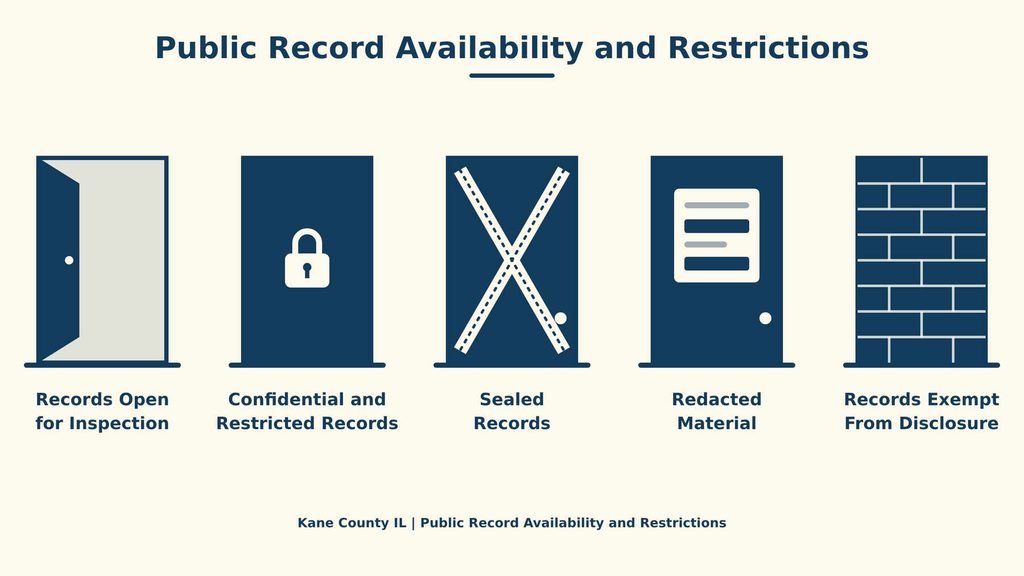
Records Open for Inspection
Most records created or maintained by Kane County departments and elected offices can be requested under Illinois FOIA. Some have online viewers, some can be examined at the holding office, and others require a written request for paper copies or archived material. An online search result is a finding aid unless the office states that it is the official record. Certification, a sealed-stamp requirement, or a request for a specific file copy may need separate handling.
Confidential and Restricted Records
Separate Illinois laws can limit records involving minors, adoptions, personnel, medical details, complainant identities, ongoing investigations, or privileged legal material. Criminal history information is subject to its own confidentiality rules. A court docket, a list of charges, and a complete criminal-history report are different records with different use rules. A request for a background check should name the exact document needed so the proper office can apply the correct law.
Sealed Records
A sealed record is closed by a court order or another recognized legal action. For public reference, official court records listings indicate that the filing office cannot remove the seal through an ordinary records request. A party involved in the court case may ask that court to change the seal, and the FOIA office can explain the restriction but cannot vacate a court order. Some court filings contain a public case cover sheet while the documents inside remain sealed.
Redacted Material
Redaction removes exempt pages, fields, or words while leaving the rest of a record open. It differs from sealing the entire file. For example, a contract may be released with personal home addresses removed while its terms remain visible. The agency should describe the material withheld and provide the legal basis for each restriction. A requester can ask for any nonexempt portion that the agency can release without undue delay.
Records Exempt From Disclosure
FOIA exemptions can cover personnel and private details, investigatory police files, pending negotiations, privileged legal or medical material, juvenile matters, adoption records, and commercial secrets. Personal privacy can be weighed against the public interest in a particular document. Exempt status depends on the record’s content and purpose, so broad labels such as “confidential” do not tell the requester whether the whole file or only certain fields are closed.
- Name the Kane County office that holds the records and the document type before submitting the request.
- Give the strongest identifiers available, such as a parcel number, case number, filing date, or exact document title.
- Ask for electronic delivery when the office permits it and the requested copy has the same legal form as a paper copy.
- If a request is denied, ask for the written reasons and the specific legal basis cited for each restriction.
- Ask for portions that can be released when only exempt fields or pages stand in the way of the remaining material.
Historical Kane County IL Public Records
Historical research often requires records from several offices. A family event may be described in a birth, marriage, probate, property, or court file, with each source using its own dates and names. Older records may be stored separately or appear on scanned images rather than in a modern database. Planning the search around the record series and holding office gives researchers the best chance of finding the complete trail.
Archived and Older County Records
Older records may sit in a county archive, a records storage area, or a historical collection operated by the department that created them. A transfer changes custody, not the need to apply privacy or sealing rules. Some archives use printed indexes, card files, or scanned books rather than modern search fields. A written request should name the office, record series, and approximate year so staff can check the correct storage collection.
Digitized and Undigitized Records
A digitized record may include a scanned image, an index entry, or both. The image preserves the original appearance, but machine-read text can contain errors that affect a name or date search. An undigitized record must be retrieved from its stored form, which can require a pull from off-site storage. The office can then apply its copy charges and delivery rules. A missing online scan does not prove that the paper record does not exist.
Historical Records for Genealogy
Genealogists often combine birth and death records, marriage licenses, probate files, deeds, and court records. Begin with the event, place, and year, then search each responsible office. Names may appear with spelling variants, initials, or older forms. For a documented family connection, ask the issuing office for a certified copy and record its date, page, file number, and any relationship shown in the document.
Public Record Accuracy and Updates
A search result is a pointer to a record, not always the full record itself. Accuracy depends on the source document, the filing date, the index, and any later corrections. Readers should compare the displayed details with the filed document before relying on a name, amount, status, or relationship for legal, financial, or family-history purposes.
Accuracy of Source Documents
The filed document or official system entry is stronger evidence than a third-party transcription. A deed image can confirm the grantor, grantee, legal description, and recording reference shown on the deed. A docket can confirm filing dates and orders entered by the court. Date fields also have different meanings, including the event date, the filing date, and the date an index entry was created. Ask which date the office considers controlling for that record type.
Outdated Entries and Data Errors
An index may preserve an old spelling, an earlier parcel number, or a name that later changed. Legal name changes do not always create a new historical index entry. Staff may also make a typing mistake, especially when a handwritten name or number is difficult to read. If a result appears wrong, keep the original display and ask the holding office to compare it with the source file.
Records That Change Over Time
Some records remain tied to a past event, while others show current data. A recorded deed normally keeps its original transaction date even when a later deed changes ownership. A tax record can change after payment, while an assessment can change after review or appeal. Court dockets can receive later orders and status updates. A current-looking index value may therefore describe a later stage of the same file.
Correcting an Incorrect Record
Send the correction request to the office that holds the record. State the case, parcel, license, or file number; identify the inaccurate field; and describe the correct value. Supporting documents can help staff verify the change. Ask the office how it documents corrections and whether the online index will also change. A corrected source record may take longer to appear in every search system than it takes to update the underlying file.
Finding the Correct Public Record
The fastest search starts with the record’s creator and custodian. Search terms alone can send a request to an office that never held the file. Once the proper office is known, the requester can describe the document, supply identifiers, and separate a missing record from a search error.
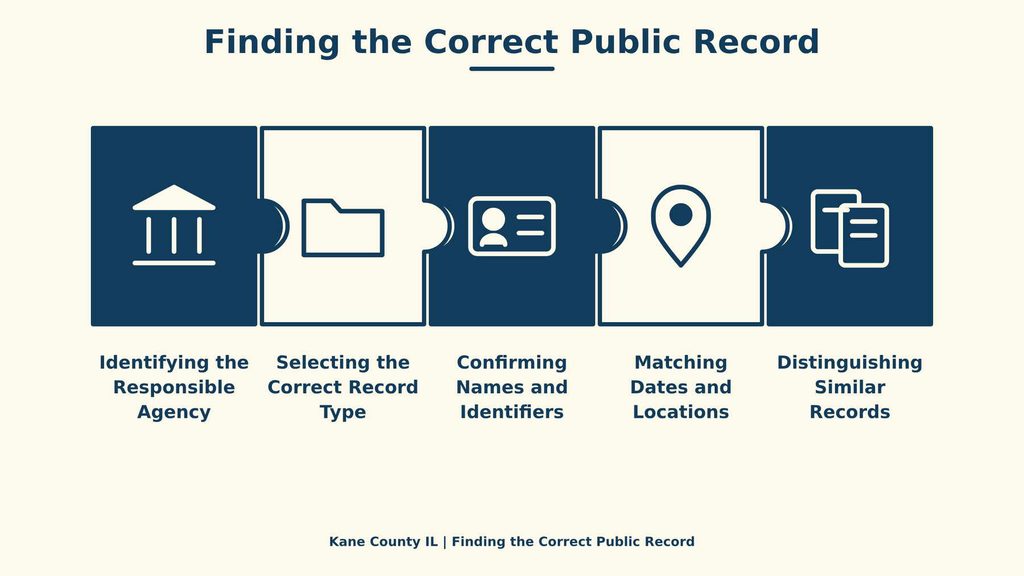
Identifying the Responsible Agency
Ask which department, elected office, clerk, or court created, received, or currently holds the record. Records can move after a transfer, so the present custodian may differ from the office named on an older document. The Kane County FOIA page provides a starting point for routing written requests. If the desired record belongs to another state or federal body, the request must go to that body rather than Kane County.
Selecting the Correct Record Type
Choose the document that answers the actual need. A recorded deed, a tax bill, and a property assessment do not carry the same details. A marriage license, a marriage return, and a divorce judgment also come from separate filing events. FOIA requests seek existing records and do not require the county to create a new document or answer a question as part of the request.
Confirming Names and Identifiers
Use the name shown on the source record when possible. Search former names, middle names, and spelling variants when a person may appear under more than one form. A parcel number, case number, license number, or file number often removes most unrelated results. Avoid including sensitive personal data that the office does not need to locate the record.
Matching Dates and Locations
Check whether the date on the record is the event date or the filing date. Property filings can cover land in a township, municipality, or other location, and the same owner may hold several parcels. Court cases can involve parties from outside Kane County even when the case was filed there. Combining the date, location, record type, and identifier gives the strongest match.
Distinguishing Similar Records
Names alone can create false matches. Two people may share a surname, or several cases may involve the same party under different roles. Compare the document type, case number, filing date, involved parties, property description, and court status. Ask for the specific filed document when the index entry alone does not settle which record you need.
Search Problems and Next Steps
Most failed searches result from an incorrect office, an incomplete identifier, an index delay, or a legal restriction. The table below identifies common problems and the next action that usually narrows the search.
Contact Information
Send a written request to the county department or elected office that maintains the requested records. Use the details below for county routing. The phone number is the county’s main line, so written-request instructions from the responsible office should guide the submission.
- Request-routing page: The official FOIA page shown under “Official Search Portal” above directs requests to the department or elected office that holds the records.
- County office address: Kane County Government Center, 719 S. Batavia Ave., Building A, Geneva, IL 60134.
- Main phone: 630-232-3400.
Frequently Asked Questions
Public records give citizens a window into government actions, property histories, court outcomes, and vital statistics. Accessing these files helps with background checks, genealogy research, legal matters, and community transparency. Most agencies keep records online, but many still require a written request. Knowing where to look and how to ask saves time and avoids unnecessary fees.
How can I request public records from Kane County?
Start by identifying the office that creates the record—such as the Recorder’s Office for deeds or the Circuit Court for filings. Visit the Kane County FOIA page for the correct mailing address or email. Include a clear description of the document, your contact details, and any fee limits. The county will confirm receipt and give an estimated completion date.
What types of public records are available online for free?
Kane County posts many files in searchable portals: property deeds, marriage licenses, building permits, and recent court opinions. Use the county’s public records viewer, enter the name or case number, and download PDFs at no cost. Some older archives may require a request form.
Can I use public records for a background check on a job applicant?
Yes. Pull criminal history, court case summaries, and civil judgments from the Circuit Court’s online database. Combine these with property and business filings for a fuller picture. Remember that certain exemptions protect sealed or juvenile records, so not every file will be accessible.
What are the exemptions that limit public records access?
Exemptions include ongoing investigations, personal medical information, trade secrets, and records involving minors. Kane County follows Illinois law, which also protects certain law‑enforcement techniques. If a request is denied, the agency must cite the specific exemption and offer an appeal path.
How do I find historical marriage licenses for genealogy research?
Visit the Kane County Clerk’s Office website and select the “Historical Records” tab. Search by bride or groom name and year, then request a copy via the online form or by mail. Fees are low, and most records arrive within two weeks.